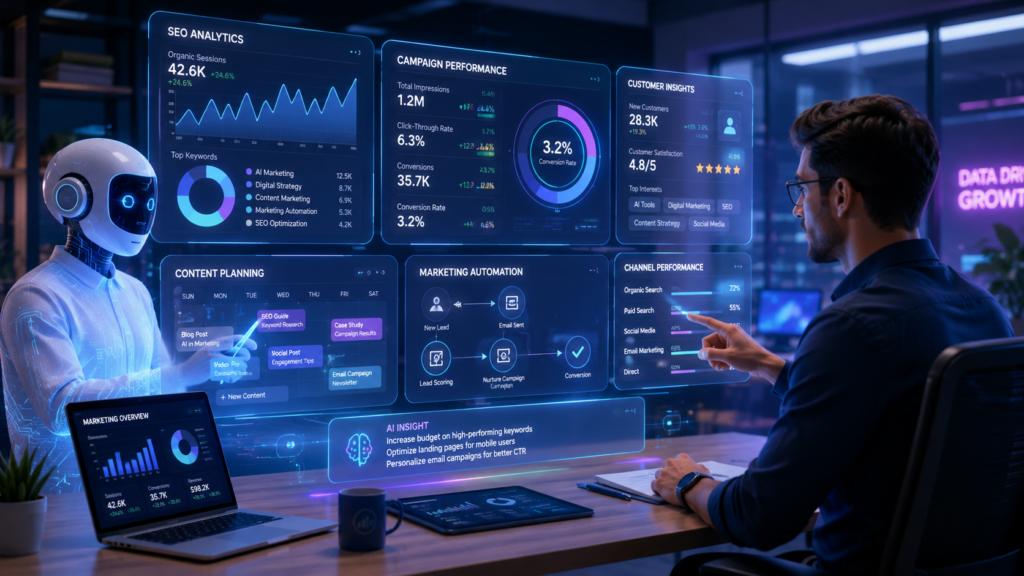
Marketing teams are always hearing about how they can hand over their workflows to an AI agent and watch their output get a lot better. This sounds really great when you hear it in a presentation. When you actually sit down and try to use an AI agent on a real task, it can get really messy.
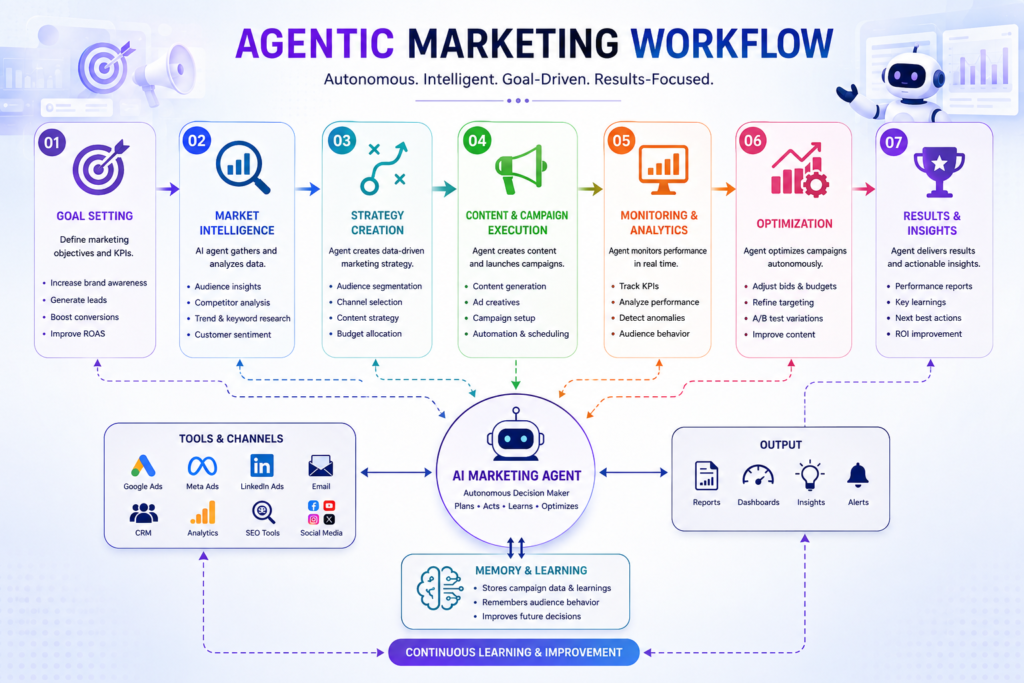
The difference between what people say about AI agents and what actually happens is where agentic marketing gets really interesting. Agentic marketing is when you use autonomous or semi-autonomous AI agents to plan, execute, and optimise marketing tasks. This can include things like researching content, reporting on campaigns, and analysing performance. The goal is to do all these things with less manual work than traditional automation tools need.
This is not about replacing marketers with machines. It is about figuring out what tasks an AI agent can really handle and what tasks still need a human to be involved. I have spent a lot of time researching and testing marketing workflows, and this article is about what I have learned. I will share the surprises I found, the mistakes I made, and a simple way to test any AI marketing agent before you start using it
What Is Agentic Marketing Really?
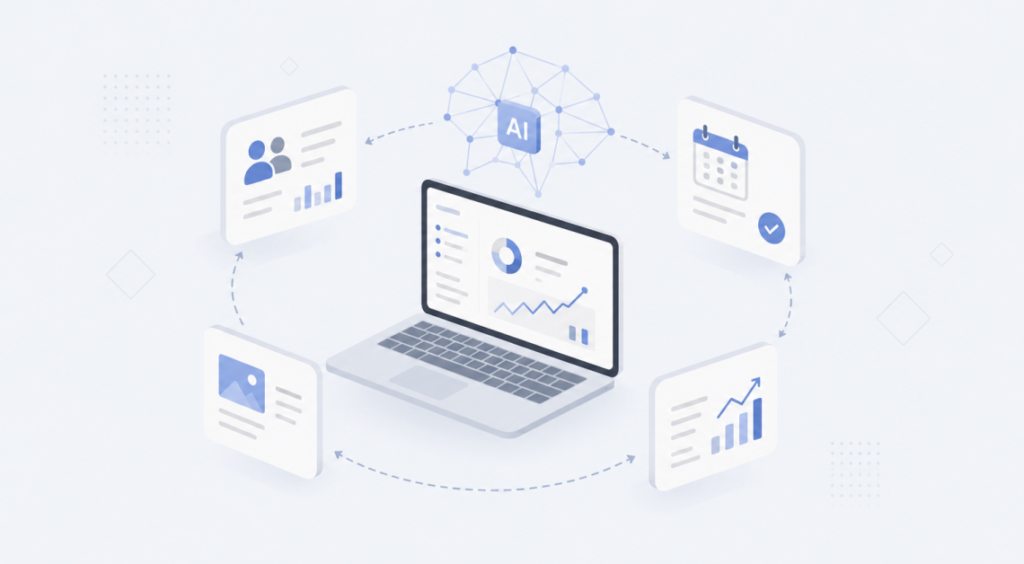
Agentic marketing is a step above AI marketing automation. A traditional automation tool follows a set of rules: if someone fills out a form, it sends an email. An AI marketing agent, on the other hand, can understand a goal, decide on the steps to reach it, and change those steps if it receives new information. This is like having a junior teammate who can help with tasks.
In life, this means AI agents can help with tasks like:
- Researching topics and creating outlines for content
- Summarizing data on how campaigns are doing
- Finding ads that are not performing well and suggesting ways to improve them
- Writing drafts of reports that a human can then review and enhance
The data from the industry shows how fast this change is happening. Gartner says that by 2028, 60% of brands will use AI to make customer interactions more personal and streamlined. This is a change that is happening quickly, and most teams are just starting to test these new tools.
What Testing AI Marketing Agents Actually Taught Me
I have not yet used an AI agent in a campaign, but I have done a lot of hands-on research and testing of agentic workflows. This is important because it is the stage that most marketers are at: they are evaluating these tools, not yet fully using them.
The biggest surprise I found was when I was testing content planning. I thought an AI agent would save me time. It did. What I did not expect was how much faster the process of coming up with ideas and outlines would be. A task that normally takes up a lot of time was done in a fraction of that time.
However, this speed came with a catch: every piece of content still needed a human to check the facts, make the messaging sharper, and ensure the tone was right. The AI agent made the first draft faster, but not the final version.
This is a way to think about where agentic marketing is right now. It helps with the stages of creating content, but it does not eliminate the need for human judgment.
The Biggest Mistake Marketers Make With AI Agents
The common mistake I have seen is treating AI agents as if they can work completely on their own. Marketers set an agent to work on a task and then walk away, thinking that “autonomous” means “no need to check on it.”
AI agents work best when they are set up in a specific way:
- You need to give them goals because vague instructions will result in output that is not what you wanted.
- They need quality data to work with because if the data is bad, the conclusions they draw will also be bad.
- You need to review their work, not just at the end, to make sure everything is on track.
If you skip any of these steps, you might end up with output that looks good but is actually wrong. That is worse than output that is obviously wrong because it might slip through without being noticed
A Simple Framework for Testing a New AI Marketing Agent
Before you start using an AI marketing agent for tasks or campaigns, it is a good idea to test it first with something small. Here is a simple process to follow:
| Step | What to do | Why it matters |
| Start with a task | Give the agent something simple to do | This limits the damage if it gets something wrong |
| Check the accuracy | Look at the output line by line, not the summary | This helps you find errors before they cause problems |
| Compare to work | Do the task manually and compare the results | This shows you if the agent is really helping |
| Gradually increase the scope | Only give the agent work if it does well on the small tasks | This builds trust in the agent based on how it performs |
This process is not glamorous, but it is the difference between using agentic marketing tools with confidence and using them just because they look impressive
Where Agentic Marketing Is Actually Headed
It is tempting to think of AI agents in marketing as either replacing marketers or as a fad that will go away. Neither of these views is accurate.
The realistic view is that agentic marketing will become a helpful tool that is part of existing workflows, not a replacement for human strategic thinking. The tasks that are best suited for AI agents now are the repetitive, data-heavy ones, like reporting and content research. Strategy and final decisions will still be made by marketers.
This is in line with what the broader market is showing. Data from research firms shows that marketing is leading the way in using AI agents for tasks like generating content and helping with decisions rather than fully managing campaigns on their own.
Common Questions about Agentic Marketing
- Is marketing the same as marketing automation? No, it is not. Traditional automation follows set rules while agentic marketing uses AI agents that can interpret goals and adjust their approach based on information.
- Do I need a campaign to start testing AI marketing agents? No, you can start testing with a low-risk task before moving to a campaign.
- What tasks are AI marketing agents best suited for now? Tasks like reporting, data analysis, and content research are starting points based on current testing and adoption patterns.
- Can AI agents fully replace a marketing team? Not based on evidence. AI agents work best as assistants for tasks, with strategy and final decisions still requiring human oversight.
Key Takeaways
Agentic marketing is moving quickly. The smart approach is to test it deliberately. Start with tasks, compare results to manual work, and keep humans reviewing the output, especially for tasks that involve brand voice or strategy. Treat “autonomous” as a description of what the AI can do, not as a reason to stop paying attention.
The AI agents that will earn a role in your workflow are the ones that prove themselves on small tasks first. Need help? See my Freelance Digital Marketer services